


The ABA launches the Autonomous Systems Governance Working Group
The Risk & Trust Management Committee of the ABA Science & Technology Section and the Cyber and Technology Law Committee of the ABA Business Law Section have jointly launched the Autonomous Systems Governance Working Group (ASG-WG).
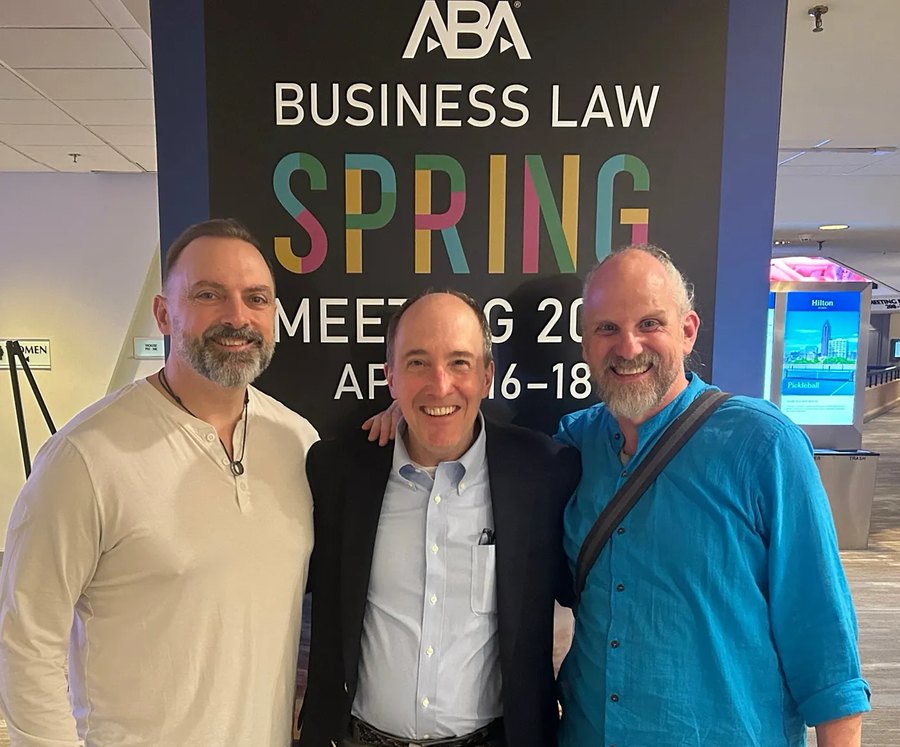
The American Bar Association's Autonomous Systems Governance Working Group held its inaugural session on April 17, 2026, in Atlanta.2 Co-chaired by Tim Reiniger and Jon Garon, the Working Group brings together legal practitioners, technologists and academics as a joint effort of the SciTech Risk and Trust Management Committee and the Cyber and Technology Committee of the Business Law Section.
The ASG-WG aligns with and advances ABA Resolution 604 (2023), which calls on AI developers and users to ensure human control, human (including legal person) legal responsibility for consequences, and transparency and traceability of autonomous decision-making and actions.1 The Working Group opened with a foundational request from industry: legal frameworks are urgently needed for guidance in governing autonomous systems.
Building minimum competencies for autonomous systems
In the coming year, the ASG-WG will hold monthly meetings, both remotely and in person, to develop minimum competencies for autonomous system governance in three areas: data management, risk management, and operations management. Participation is welcome from data science and IT experts, domain experts in regulated and other affected industries, and attorneys from a variety of specialties.
Co-Chair Reiniger sees this as a solid approach. “Fortunately, legal doctrines already exist, refined over four centuries, in property, agency, contract, and products liability law. The problem is not the absence of legal doctrines. It is the current confusion of whether and how to apply these doctrines to emerging autonomous systems, including agentic AI.”
Runtime authority and the limits of identity
Current AI governance frameworks conflate attribution with accountability, and authority with identity. But identity credentials can establish only who is acting, not whether an agent is acting on a party's behalf and within that party's authority. Identity credentials do not establish whether the action is authorized on behalf of this specific party at this particular moment. The authority question requires a different instrument.
For legal accountability to be enforceable, a key governing principle will likely be authorization exhaustibility: the idea that authority must activate at the moment of execution and be consumed immediately thereafter. Standing permissions that persist across actions are legally incoherent in systems operating at machine speed under delegated authority. Each action must stand on its own authorization.
Three proposals before the Working Group
The Working Group will consider a variety of currently proposed solutions to the urgent need for runtime-action authority governance constraints on AI agents.
- Role-Based Containment (RBC)
- Proposed by data science and informatics experts, RBC entails a novel Ward-centric governance model built on four legally distinct instruments. The Ward is the party that directly bears the consequences of autonomous action and holds a proprietary interest in the protected asset. All authority derives from, and must be traceable to, the Ward's protected interest, and authority activation requires live human presence at the start of the governance chain.
- Autonomous Action Runtime Management (AARM)
- A second solution the ASG-WG will consider, focused on runtime management of autonomous action.
- Agency-law delegation
- A third approach, put forward by a group of experts at MIT and Stanford, advances delegating authority to AI agents under existing agency-law principles.
A glossary, a schedule, and a call for proposals
The Working Group will soon announce a website page where interested parties and participants can access meeting schedules, agendas, and materials. The WG will develop a glossary of terms to harmonize current legal, technical, and business usage of the same or similar terms.3 The WG will also begin soliciting minimum competency proposals for autonomous system governance from industry, data science, and legal experts.
The Autonomous Systems Governance Working Group operates under the Risk and Trust Committee of SciTech within the American Bar Association's Business Law Section. Participants so far include legal practitioners, Direct Trust, representatives from the healthcare and financial services industries, and academia, including the University of South Florida and the University of North Carolina.
What matters about this launch is not any single proposal on the table. It is that the profession that will ultimately have to assign responsibility for an autonomous action has begun the work of deciding how, before the case law is written for it by accident. Governance is arriving at the same conclusion from several directions at once: authority for an autonomous action has to be decided at the moment the action is attempted, and traceable afterwards to a human who bears its consequence. The Working Group is now the venue where the legal profession tests what that requires.
References
- Resolution 604. American Bar Association, House of Delegates, August 2023.
- Autonomous Systems Governance Working Group, Inaugural Session. American Bar Association, SciTech Risk and Trust Management Committee and Business Law Section Cyber and Technology Law Committee, Atlanta, Georgia, April 17, 2026.
- ASG-WG Proposed Lexicon. American Bar Association Autonomous Systems Governance Working Group, April 2026.