

Independent signals, one architectural gap
Something is happening in the AI governance space that has never happened before. Independent communities in commercial, regulatory, legal, and national security are converging on the same architectural gap from entirely different directions, in the same week.
- June 22
- The Five Eyes cybersecurity agencies (NSA, CISA, UK NCSC, Australian ASD, Canadian CCCS, New Zealand GCSB) issued a joint statement: “Secure-by-design and secure-by-default must become standard practice, not an aspiration.”1
- June 24
- The American Arbitration Association and a coalition including Google, IBM, and Circle launched the Legal Context Protocol, an open standard for the legal terms, consent, and dispute-resolution layer of agentic commerce.2 The same day, an HTTP-native identity protocol for AI agents, x401, was announced with contributions from OpenAI, Okta, and others.
- June 25
- The ABA's Autonomous Systems Governance Working Group held its first monthly meeting. Its proposed lexicon, including Ward, Warrant, Warden, Action-Time Authority, and Exhaustibility, entered formal institutional consideration.3
- Throughout this period
- Berkshire Hathaway, Chubb, and Travelers have been quietly exiting autonomous agent coverage. State regulators have approved more than 80 percent of AI exclusion requests, specifically targeting autonomous-agent workflows in which no human is in the approval chain.4
These are not related events. They are independent signals converging on the same architectural gap: autonomous systems are producing real-world consequences without authority that is evaluated, exhausted, and evidenced at the exact moment of execution. The gap has a name. The gap has a structural answer. What it does not yet have, in any deployed governance architecture, is the enforcement plane that closes it. That enforcement plane is the Warden.
The problem no credential can solve
The current digital governance infrastructure was built on a foundational assumption: that the principals acting are humans. A human presents a credential, a system grants permission, and the human acts. The governance question is asked once, at the point of credential presentation, and the answer persists as standing permission until explicitly revoked.
That model worked because humans were in the loop. Autonomous systems remove that human entirely. An agent receives a permission, inherits a session, or operates within a scope established at some earlier point, and then acts continuously at machine speed across systems and contexts, producing real-world consequences that no human has individually reviewed or authorized at the moment they occur. In that architecture, the link between permission and authority breaks.
The identity community's response, including x401, non-human identity frameworks, and digital identity codes for AI agents, is to extend the credential infrastructure to machines. The instinct is understandable. The instrument is wrong. An identity implies accountability. A machine cannot be accountable. Therefore, a machine must never have an identity. It needs an identifier: a structural reference point that anchors the evidence chain without displacing the human who must answer for what the chain produces.
What Action-Time Authority requires
Action-Time Authority is the requirement that authority be evaluated and consumed at the exact moment an agent executes an action. Not granted in advance and allowed to persist. Not inherited from a prior session. Activated once, evaluated against current conditions, and exhausted immediately upon use.
This is not a new requirement. It is the doctrine of exhaustion applied to governance, the ultra vires principle that action beyond authorized scope is void, and the Conveyance Moment from property law that validity is evaluated at the instant of action, not retroactively. These are legal instruments refined across four centuries of property law, agency law, and fiduciary law, and they encode exactly the governance logic autonomous systems require.
Action-Time Authority requires three things at every execution boundary:
- The Ward
- A named consequence-bearer whose current interests bound the outer scope of what any agent may do.
- The Warrant
- A single-use authority instrument evaluated against those interests at the exact moment of execution.
- The Warden
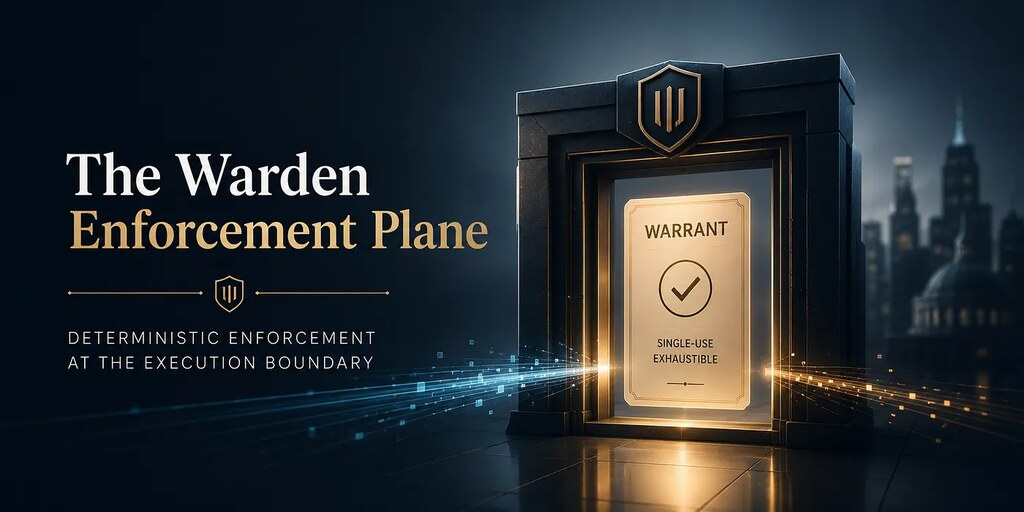
- A deterministic enforcement mechanism that either passes or refuses the action with no interpretive latitude.
Action-Time Authority without the Warden is a concept without an enforcement layer. The Warden gives it structural teeth.
What the Warden is, and is not
The Warden Enforcement Plane is the deterministic runtime subsystem responsible for Warrant token admission evaluation, delegated mint execution, and execution-boundary enforcement. It is the architectural nucleus of Action-Time Authority.
Before any agent action produces a real-world effect, the Warden evaluates the proposed action against three structural conditions:
- Existence. Does a valid Warrant exist for this specific action?
- Traceability. Is it traceable to the Ward's protected interest through an accountable Governance Chain?
- Admissibility. Is it admissible under the conditions that currently apply?
If all three are satisfied, the Warrant is passed to the Agent for execution, exhausted upon use, and a Receipt is produced as commitment-grade evidence. If any condition fails, the action does not execute, and a denial record is produced immediately.
The Warden does not execute actions; that is the Agent's function. The Warden evaluates the Warrant and either passes it to the Agent or denies it. This separation matters: the Warden seals the governance record at the moment of authority exhaustion, before the Agent touches it and independent of what the Agent subsequently claims. Self-attestation is not governance. It is provenance with a timestamp.
The Warden is also not a monitoring tool. Monitoring observes what has already occurred; the Warden evaluates what is about to occur. A monitoring system can describe a harmful action in perfect detail without ever having been able to stop it. The Warden makes certain classes of action structurally inexpressible. There is no harm to reconstruct because there was no mechanism for the unauthorized action to execute.
Why policy-based governance cannot do this
The industry consensus defines AI governance as a set of policies, processes, and tools designed to ensure AI systems behave ethically, reliably, and in compliance with regulations.5 This is structurally insufficient for autonomous systems, for three specific reasons.
- Policies cannot operate at machine speed. An agent executing thousands of actions per second cannot pause for policy evaluation at each step. Automated policy evaluation requires a deterministic enforcement mechanism at the execution boundary: the Warden.
- Policies cannot prevent. They can prohibit, detect, and penalize after the fact, but cannot structurally prevent an action from executing. The Warden makes unauthorized actions structurally inexpressible; the harm that did not execute is never logged, because it never occurred.
- Policies cannot produce commitment-grade evidence. A policy violation is discovered by an audit. The Warden produces a Receipt at the moment of Warrant exhaustion, sealed by the enforcement mechanism, not the executing agent, and independently verifiable without the originating system being present.
Policy-based governance asks: how quickly can we respond when something goes wrong? The Warden asks: how do we ensure nothing executes that should not? These are different instruments answering different questions.
The Warden in the current governance debate
- The insurance market
- Underwriters require three things to price a risk: who was harmed, what authority existed at the moment of effect, and whether that authority was within legitimate scope. Permission systems can only answer these questions at the system level. The Warden answers all three at the action level. Berkshire Hathaway, Chubb, and Travelers have not exited autonomous agent coverage because they believe AI is uniquely dangerous; they have exited because they cannot answer the three questions at the action level. That is not a theoretical argument. It is a portfolio decision.
- The standards bodies
- An IETF working group has identified the need for action evidence that fails closed and is testable by independent implementations. The Warden fails closed: no Warrant, no execution. An independent, peer-reviewed analysis of EU AI Act compliance, published in April 2026, concluded that the essential requirements of Articles 12 to 14 can only be demonstrated through action-level records of human authority exercise.6 The Receipt derived from an exhausted Warrant is that record.
- The LCP and the identity stack
- The Legal Context Protocol establishes the legal terms, consent, and dispute resolution framework for agentic commerce. The x402 protocol provides the payment layer; x401 provides the credential layer. None of them provides the governance layer. LCP answers what was agreed and under what terms. The Warden answers whether this specific action was authorized at the moment it executed, and whether the Receipt proves it. Both are required; neither substitutes for the other.
- The Five Eyes
- “Secure-by-design and secure-by-default must become standard practice, not an aspiration.” That is the Ward model's central claim, stated as national security doctrine. The Warden Enforcement Plane is secure-by-design at the execution boundary: deterministic, fail-closed, producing commitment-grade evidence at the moment of effect.
What changes when the Warden exists
- For deployment
- Every consequential action is governed at the execution boundary. No action may produce an effect without a valid Warrant, no Warrant may be issued without traceability to a named Ward, and no execution may occur without an independently verifiable Receipt. The liability surface is bounded at the action level, not the system level.
- For accountability
- The Receipt chain derived from single-use Warrants is the attribution mechanism for regulatory purposes, not inference from credentials presented at admission. In a multi-agent chain where each node has permission but no node has traceable authority, the Warden makes traceability structural: every Receipt references the Warrant that authorized it, the Ward it served, and the Governance Chain through which it was issued.
- For insurability
- A deployment with a Warden Enforcement Plane can answer the underwriter's three questions at the action level: bounded liability surface, commitment-grade evidence, a structurally produced accountability chain. That is an insurable system.
- For the Ward
- The Ward is the party that directly bears the real-world consequences of autonomous action. Every action executed with a valid Warrant is a governed consequence: traceable, evidenced, accountable. The Warden is what makes the difference between a Ward who is protected and a Ward who is unprotected, structurally rather than probabilistically.
The Ward is why the Warden exists.
The governance invariant
The Ward model's central claim is that authority must be structural, not aspirational. The Warden Enforcement Plane is where that claim becomes operational. Without it, Action-Time Authority is a legal principle with no enforcement layer. With it, it is a structural invariant that cannot be circumvented at the execution boundary, because at the execution boundary there is nothing to circumvent.
Every governance conversation in the autonomous systems space right now is converging on the same point. The insurers, the standards bodies, the legal community, and the national security agencies are asking the same question from different altitudes: what stands between an autonomous system and the real-world consequence it is about to produce on behalf of a person who bears it? What holds at the boundary between authority and effect, at machine speed, is not a policy. It is the Warden.
References
- Five Eyes Cybersecurity Agencies Statement. National Security Agency / Central Security Service, June 22, 2026.
- AAA and Industry Leaders Launch Legal Context Protocol for Agentic Commerce. PR Newswire, June 24, 2026.
- ASG-WG Proposed Lexicon. American Bar Association Autonomous Systems Governance Working Group, April 2026.
- Corporate Insurers Are Starting to Back Away from AI Risk. Fast Company, May 14, 2026; Berkshire Hathaway, Chubb Win Approval to Drop AI Insurance Coverage. The Information, April 23, 2026.
- Beharry, R. and Pahwa, S. Data and AI Governance: A Complementary Duo for Enterprise Success. IBM, 2025.
- Nannini, L., et al. AI Agents Under EU Law: A Compliance Architecture for AI Providers. arXiv:2604.04604, April 2026.